
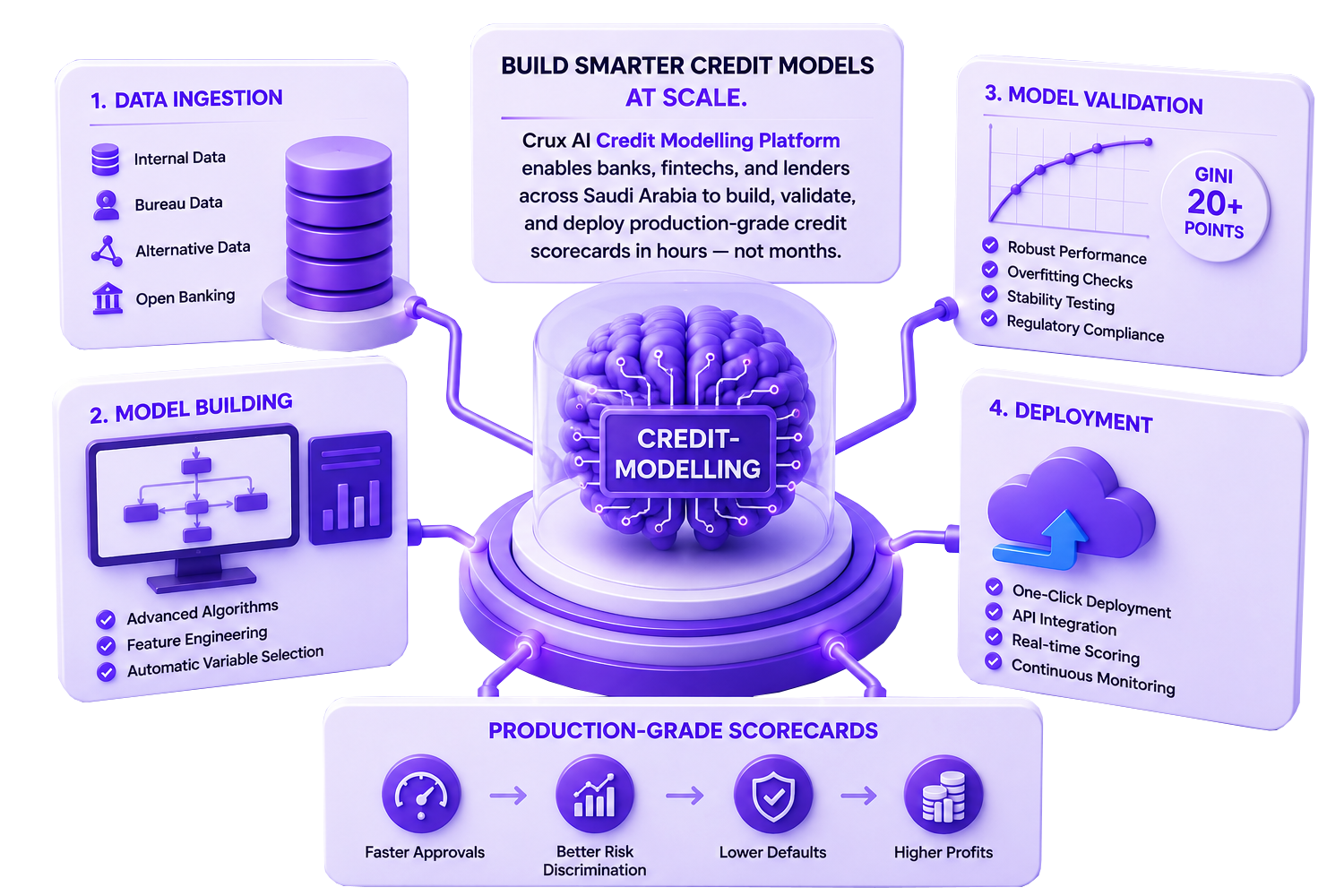
Build smarter credit models at scale.

The Crux AI Credit Modelling Platform lets banks, finance companies and fintechs in Saudi Arabia build, validate and deploy production-grade credit scorecards in days, not months, with every decision explainable to risk, audit and regulators.

No-code builder Explainable decisions REST API deployment You own the model IP
3scorecard types on one platform
100+variables derived automatically
APIone-click deployment to your systems
crux / credit-modelling
Crux AI Credit Modelling Platform: scorecard model builder and performance dashboard
Scorecard types

One platform. Three scorecards.

Application, behavioural and collection models are built, deployed and monitored from the same place, so the data, definitions and governance are shared across the credit lifecycle.

01 Origination

Application scorecards

Assess new applicants instantly using many more data points than a traditional model: financial, behavioural, bureau and alternative data. Approve more creditworthy borrowers safely and at speed.

  • Real-time credit decisioning
  • Multi-source data fusion
  • Consumer and SME lending
  • SHAP-explained decisions
Explore application scorecards
02 Monitoring

Behavioural scorecards

Re-score existing customers continuously using live transaction data. Spot rising stress early enough to act on limits, outreach and provisioning before losses appear.

  • Continuous portfolio monitoring
  • Early delinquency signals
  • Dynamic risk re-scoring
  • IFRS 9 staging support
Explore behavioural scorecards
03 Recovery

Collection scorecards

Predict the chance each delinquent account will cure and assign the most cost-effective strategy automatically, so agents spend time where a conversation changes the result.

  • Cure probability scoring
  • Agent workload optimisation
  • Omnichannel strategy engine
  • Fair-treatment controls
Explore collection scorecards
model performance / variable importance

Application scorecard · variable importance

Illustrative output, not client data

Payment history92%
Credit bureau score88%
Income stability84%
Debt-to-income ratio79%
Employment status67%
SHAP explainability · reason codes · full audit trail
Core capabilities

Empower credit teams from data to deployment

A complete toolkit for every stage of the model lifecycle, usable without a large data science team or long IT sprints, and built around SAMA, IFRS 9 and Basel expectations.

360° data integration

Connect internal, bureau and alternative data. Imputation, bias checks and automated variable derivation come built in, with no manual engineering.

AI model builder

Build consumer and SME scorecards using ensemble ML, deep learning or traditional WoE logistic regression, with auto-derived features and automatic benchmarking.

Full parameter control

Tune binning, PD calibration and variable-selection thresholds from a no-code interface, so the business team stays in control of the model.

AI toggle: best of both

Switch between traditional regression, ensemble ML or a hybrid. Interpretability for regulators and accuracy for the business, whichever the use case needs.

How it works

Data to deployment in six steps

What used to take a long development cycle is compressed into a guided workflow, with validation, explainability and model documentation produced along the way instead of afterwards.

01Data ingestion

Connect any source. Automated validation and data-quality scoring.

02Data treatment

Auto-clean, reduce bias and apply WoE transformation.

03Feature engineering

100+ variables derived automatically, no manual engineering.

04Model builder

Set parameters, choose the algorithm and generate the scorecard.

05Validate

Cross-validate, explain with SHAP and produce regulatory documentation.

06Go live

Deploy with one click as a REST API, then monitor drift with automatic alerts.

Why Crux

Credit intelligence built for the Saudi market

No-code

Any credit analyst can build a production model

A zero-code interface backed by enterprise-grade modelling. Analysts with or without a data science background can configure, validate and deploy scorecards without writing code, and data scientists keep detailed control when they want it.

Governance

Regulator-ready

Every decision is transparent, documented and auditable for supervisory review.

Integration

API-first

Connects to your loan origination and core systems through a documented REST API.

Scale

Grows with you

From fintech start-up to tier-one bank, without switching vendors.

Deployment

Cloud, hybrid or on-premise

Deploy where your policy requires. Your model IP stays yours.

The basics

What is an AI credit modelling platform?

An AI credit modelling platform lets a lender build predictive scorecards using machine learning and statistical techniques. It automates feature engineering, validation, monitoring and deployment, which shortens development from months to days while keeping every decision explainable.

Traditional scorecard development relies on specialist data scientists, long manual feature engineering and a separate validation cycle. A modern platform automates the lifecycle so Saudi banks, fintechs and digital lenders can build IFRS 9-aligned, Basel-aware models at the pace the market demands.

Legacy credit modelling
Crux credit modelling platform
Months from data to live deployment
Data to production in days
Needs a dedicated data science team
Credit analysts can build models without code
10–30 manually selected variables
100+ variables derived automatically
Explainability and audit trail added afterwards
SHAP explanations and audit trail built in
Separate tools for each scorecard type
Application, behavioural and collection on one platform

Actual timelines depend on data readiness and your model-approval process. Every model is benchmarked against your current scorecard before it goes live.

Questions

Answered plainly

What is an AI credit modelling platform?

It lets a lender build predictive scorecards using machine learning and statistical techniques. It automates feature engineering, model validation, monitoring and deployment, which shortens development from months to days while keeping every decision explainable to risk teams, auditors and regulators.

How does AI improve credit scorecard accuracy?

AI can evaluate many more variables at once, including behavioural, transactional, bureau and alternative data, and capture non-linear patterns that a traditional model built on a few dozen hand-picked variables can miss. The size of the improvement depends on your data, so Crux benchmarks every model against your current scorecard on a held-out sample before anything goes live.

Can AI credit models meet IFRS 9, Basel and SAMA expectations?

They can be built to. The platform produces SHAP-based explanations, reason codes, validation reports and a model governance audit trail, which support IFRS 9 provisioning, Basel credit risk practice and SAMA expectations for automated credit decisions. Your risk and compliance teams remain responsible for model approval and regulatory interpretation.

Do we need a data science team to use it?

No. The no-code interface lets credit analysts configure data, binning, variable selection and algorithms without writing code, and data scientists can still tune parameters in detail. Crux supports your team through onboarding and first model builds.

How are models deployed into our systems?

Approved models are published as REST APIs that your loan origination or core banking systems call for real-time decisions, or run in batch for portfolio scoring. Deployment can be on public cloud, private cloud or on-premise, and your organisation keeps ownership of the models it builds.

Get started

Ready to transform your credit risk process?

In a focused 30-minute session we look at your current scorecards and data, show how a model would be built on the platform, and outline what a first deployment could look like.

Saudi Arabia & GCC ready Built around SAMA expectations Dedicated onboarding support